Tuesday, 29 November 2016

Asset classes


List of Different Asset Classes for Investing


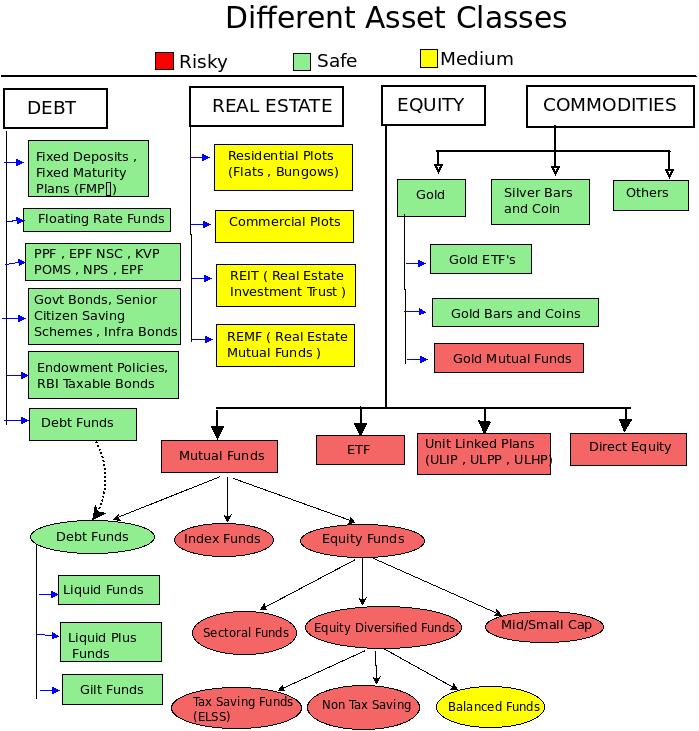
Below is the list of different Asset classes one can consider for investing in Indian markets. For building a successful balanced portfolio one has to understand different asset classes and as per their risk appetite, one has to build his/her portfolio so that it’s optimal from his risk return point of view. In this post you will look at different asset classes and their sub categories with the risk potential. This is not an exhaustive list of categories, however it covers most of them. See the Chart Below
[ad#big-banner]
Readers who are reading it in Email can see thechart here or visit blog article

Points to Remember

  • The above chart does not contain exhaustive list of products and asset classes. See What is Asset Allocation
  • REIT and REMF are yet to come to India, they are not there in market yet
  • Mutual funds classification is not complete. There are different ways to classify mutual funds, the one I have shown is one of the way. Here is the list if good Equity Funds and Debt oriented Mutual funds
Comments! I am sure I missed out somethings in this chart, please suggest

Trading is not about only winning

Mistake 4# – I thought trading is all about WINNING

Psychology plays a big role in being a good trader. From the childhood we are programmed to WIN and that same mindset takes over rational thinking in stock markets trading too. We want to WIN on all the trades , It’s hard to accept that you were wrong , being wrong means taking a LOSS . LOSS equals FAILURE and we are never taught properly how to take failures. And that’s exactly what happens in trading, novice traders don’t cut their losses fast, they let them grow (ego) and keep hoping that they will WIN
This is what also happened with me. When I bought an option for a stock, every time I wanted to WIN, every time I wanted to make profit on that option. I thought I will become a great trader , if I WON more and more ..
I was so WRONG
Winning MORE times is not same as making MORE money in stock markets trading. I know some of you who are reading this are confused with this statement , but let me explain this important point
So when it comes to stock market trading, you can’t choose how many times you WIN or LOOSE, but can control HOW MUCH you will win or lose !
All you can do is 3 things
1. You can control how fast you can get out of loosing trade (getting out of a bad decision)
2. You can control how long you will stay with a winning trade
3. And You can control when you will take the decision using your knowledge.
WINNING MORE , but still LOOSING
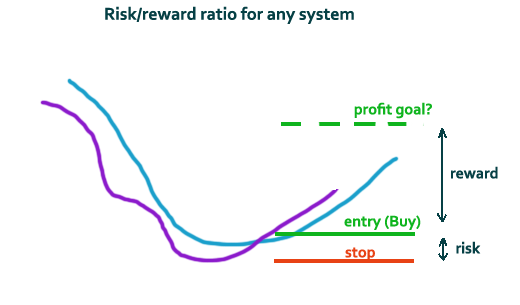
Every trade you make in stock market, you should make sure that your profits potential is generally much higher than the risk potential. Here is how it should look like
risk reward of money management system
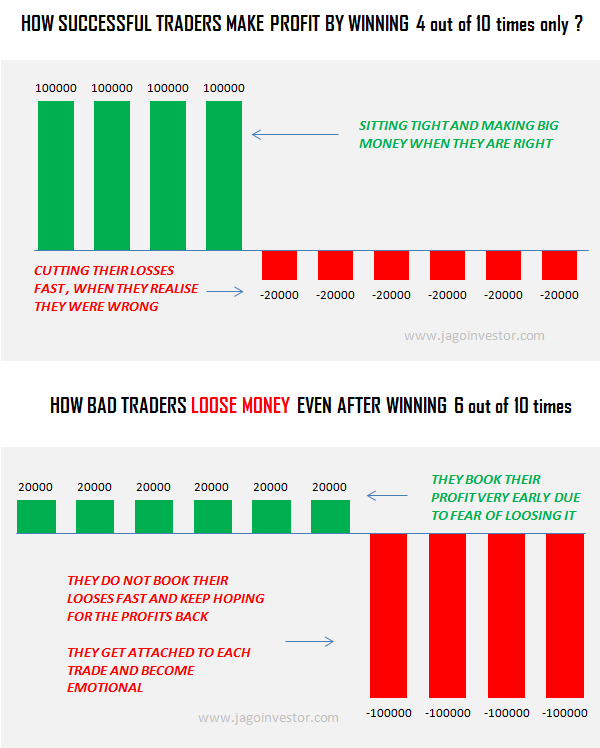
It’s very much possible that a trader wins 6 out of 10 times and still looses the money and in the same manner, it can happen that a trader wins just 4/10 times and still makes a lot of money.
Let me explain this with an example. Let’s say a person has Rs 10 lacs to start his trading .
A good trader wins just 4 times, but he makes sure that he will make big win and every time he makes a bad decision, he cuts the loss fast. And in same way, a bad trader might win 6 times , but every time they are in hurry to book their profits (so they earn small every time) and when they are in loss, they do not book their losses fast (no money management rules in place) and hence let their losses grow because they can’t accept they made mistake (Ego) . The chart below will explain you this .
Why Winning in stock markets is not important
This is the only big difference between a good trader and bad trader .
Conclusion
Today I have shared my mistakes I did when I traded OPTIONS and I hope you will learn from my mistakes . But this can just be starting point only, you will only learn when you get on the ground and do the real trading. Till then it’s just a practice no matter what you do.
It’s extremely addictive to trade and if you are like me, you will feel a great thrill trading either stocks, futures or options (or any other instruments) , while I didn’t succeed in trading, I at-least know why I failed, I at least came to know my weakness and now I can improve upon it. I can at least help others to not make the same mistakes I did.
Also in future, if I get into trading again, I am sure I will be 10X better compared to earlier version of mine. I know it will still be very though , but I can try at least and when I stopped my trading, somewhere I felt bad about leaving it. I felt as if I am turning my back and got a feel of leaving the battle ground , but it was a right decision because I could have damaged my own net-worth to a big extent had I not stopped.
I would love to hear what you feel about the points I shared and if you would like to share your own experiences

Money manegment is the kye

Mistake #3 – I didn’t realize that Money management is supreme

I personally think this is the most important part of being a successful trader . The biggest reason for my failure was that – I was very casual about money management and made the biggest mistakes in this area. Money Management in context of trading is all about managing your overall money and how much part of your overall trading capital you put at risk in each trade.
I will give you an example – Let’s say you have set aside Rs 10 lacs for stock market trading . Now let’s say you make 2 rules
Rule 1 : You will never use more than 20% of your capital in any given trade, no matter how promising it looks to you. Which means out of Rs 10 lacs you have , you will not put more than Rs 2 lacs on any single trade (so even in worst case, you will lose only 20% of your capital)
Rule 2 : The maximum loss you will allow on any give trade is 10% , which means that if you put Rs 2 lacs on a trade, you will not let the loss cross 10% , which is just Rs 20,000
If you see these 2 rules, you can see that the maximum loss in any single trade will not be more than Rs 20,000 which is 2% of your overall capital. So assuming you make 1 trade each month, you have 50 months of quota with you to go wrong fully
No one is so bad that they will make bad decisions every time, you make good and bad both decisions , but important point is that you should survive in markets till that time when you start taking right decisions .. Hence it’s important to be in the game and unless you take money management very seriously , you are bound to get out of the game some or the other day. This is exactly what happened with me. By the time I started realizing that I am moving from “bad trader” to an “average trader” zone , my capital was over and I was already in loss and I never went back to the game itself.
Why one should use Money management ?
The biggest reason why money management should be used is that it does not expose you heavily to the risk on a broader level, even if there is very high risk on individual trades.
And the next big reason why money management is crucial is that it brings some kind of consistency in your growth overtime.
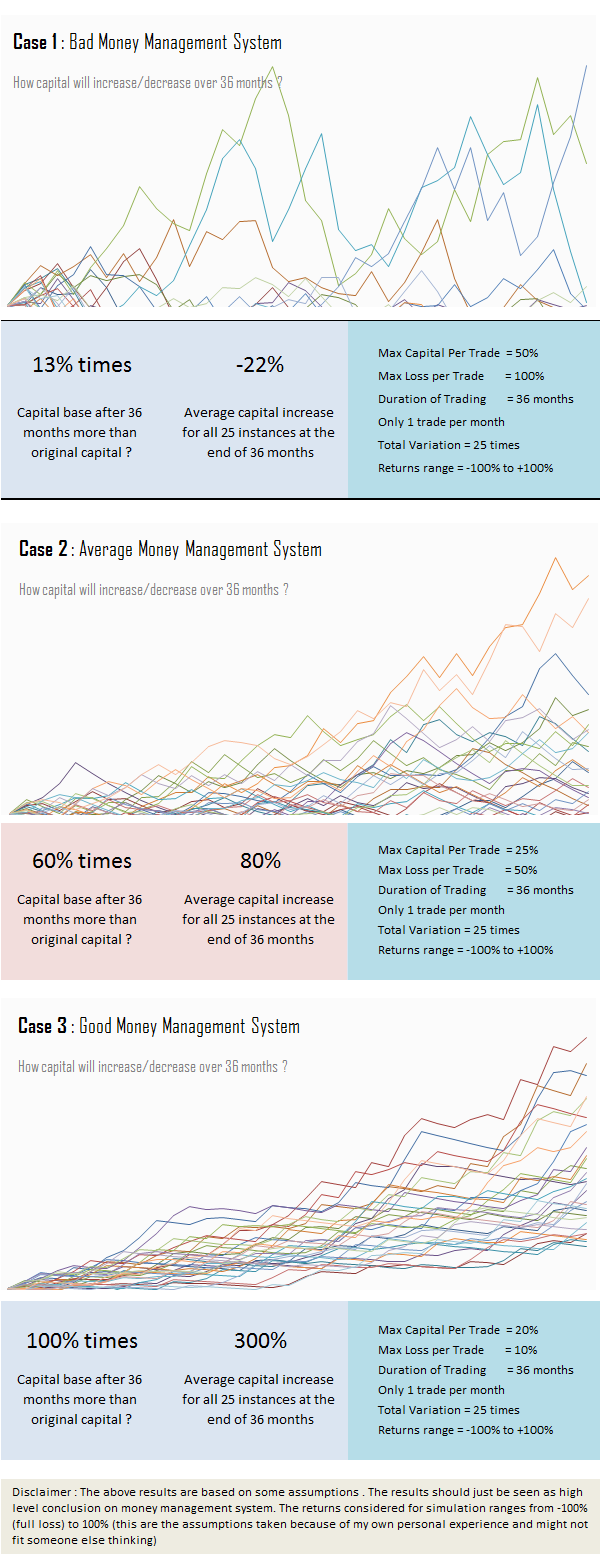
Below you can see 3 versions of money management, which is BAD , Average and GOOD money management, where the overall risk taken on a single trade is moving from high to low.
I did some simulation on excel where we are measuring how capital will grow over 36 months (assuming 1 trade is done in a month) . I ran 25 tests and plotted them on a graph together. You can see how in case of bad money management the growth of capital is very random, unpredictable and varies from very high (lucky) to very low (unlucky)
But in case of good money management , the growth of capital a trader has moves up over time and with high consistency .
money management system case study
So to sum up , I would say money management system is like having a great stamina . If you are there for longer time in markets, in a way you win the battle to some extent.

Listen to the market

Mistake #2 – I went against the Trend

What I have seen is that all the new traders somewhere want to challenge the markets and want to predict when markets will fall and when it will rise. They want to predict when the trend will reverse. They want to catch that top or bottom. This is the essence of where most of the failed traders are stuck . If markets are rising , somewhere inside me, I wanted to catch the top and wanted to prove as if I “almost” know that now markets will fall OR if markets were going down. However in this process , I realized that all the time I was just trying to swim against the trend, If markets were going up, I tried to predict when it will fall and how much and vice versa, and in that process I never stayed with the trend. There was some kind of fun in going against the trend. It was very tough to accept that markets can be simple (not easy)
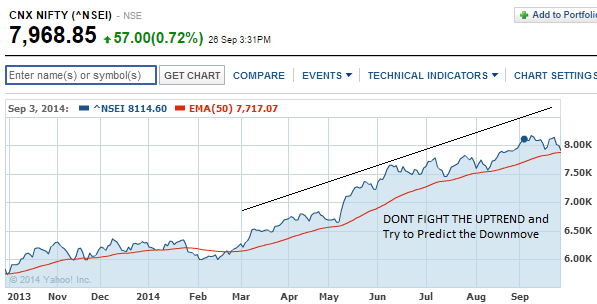
Below you can see last 1 yr graph of NIFTY Index and see that there has been an uptrend in market and it has risen from 6000 in 2013 to around 8000 now . That’s 33% increase , but imagine someone who didn’t stay with the trend and always tried to predict when will market fall and looked at markets with suspecting manner and never got in the trend itself.
Don’t go against market trend
So just make sure that you never go against the flow in general. If I have to compare this trend following with some adventure sports, then I will compare it with Surfing, where you ride on the flow of the water. The flow of the water itself will take you with it, you just need to stay with it. Imagine what happens if you try to go against the water flow, the chances of you getting crushed is high.
So, try to identify the overall trend (upside , downside) and then make sure whatever is your trading style , be with the flow itself.
There is nothing wrong in having a contrarian view and predict when the markets will turn its direction, but be sure you know how you will take that decision. You can surely take a call against the trend , but make sure you accept that you were wrong in case you fail. Don’t try to prove yourself right if you are wrong, because it’s only going to harm you.

Sunday, 27 November 2016

To much knowledge is bad

Mistake #1 – I focused too much on Knowledge

When I entered into stock markets, I was of the impression that I need to acquire a lot of knowledge on how things work, how various strategies work ? How technical analysis can help in trading ? I learnt all the technical indicators, back tested them on the past data, wrote lot of programming scripts to test my hypothesis. I even went on to download lots of videos online and watched it over and over for many months and I realized that my knowledge had gone up significantly. I now understood lots of concepts, strategies, complex terms .
I could see a chart and instantly see lots of hidden patterns and could tell more than a normal person who does not know how to read a chart.
But then, over the months, I realized that “knowledge” is just a secondary element to trade successfully in stock markets. Almost all the good traders around the world agree that “knowledge” does not contribute more than 10-15% in being a successful trader. It’s an important thing , but certainty not the holy grail
I am not saying that one should not focus on “knowledge” part, all I am saying is that it’s not that KEY thing to succeed. Over knowledge will only create problems for you. One of the famous stock trader Ashwani Gujral says in his book – “How to make money trading derivates” – that as per his experience over many decades, he feels that knowledge of charts etc contributes to just 10% of success for any trader. Here is the chart which explains what he mentioned in the book
elements of successful trading
So, learn things in stock market and then concentrate on the other important elements which you will learn in some time. Dont overthink about knowledge part.

Risk management

Many people overlook the importance of managing risk in their positions and trades. As a trader or investor, this is the only thing that we can control. We cannot control the directions of the markets. We also cannot control whether we will win or lose in any position we take. The only thing within our control is the amount of loss we will suffer.
To most traders, risk management means simply setting stops. Many investors do not even do this to control risk. However, there is much more to managing your risk in the markets. You wouldn't drive onto a bridge if you have noticed that most of the supports have crumbled would you? Would you walk onto a frozen lake after seeing a "Thin Ice" sign posted and several cracks showing in the ice itself? Of course you wouldn't, that is because you observed the environment and realized that it was too risky to proceed.
We need to observe the same discipline when we are involved in the financial markets. To analyze risk before trading or investing, we must look at the current market environment, the security's environment and the trend. Are we in a danger spot that would preclude us from taking a trade? Suppose the markets were bearish, your security has just released disappointing earnings and is near supply on your trading time frame. Would you buy shares just because prices moved up slightly? Most likely you wouldn't. Even though you have a short term bullish move, the overwhelming bearishness of the markets tells you that the environment is risky and the reward isn't large enough to endorse a long position.
Many people can plan a trade, but not all have the ability to analyze the risk and manage the risk in a manner that ensures their financial survival in the markets when things go wrong. And believe me, they will from time to time.
There are three main risk management techniques that I wish to discuss here:
Frequency
In trading and investing, frequency refers to the number of positions we will open. The issue with many traders/investors is that they will try to take all opportunities they see and open positions with only a marginal chance for success. They do this due to fear of missing opportunities and profits in the markets.
Successful traders/investors have the discipline to be more selective in their opening of positions and take only those trades that meet specific criteria outlined in their plan and that offer a high probability for profits. As a new trader/investor, you should limit the number of trades you take. This will force you to look for the right opportunities to trade rather than jumping in on any small move in the markets. Remember, even if you miss an opportunity, there is likely another one coming along very soon.
Duration
The second technique is duration, or the amount of time spent in the position. The longer you spend in a position, the greater the chance for adverse price movement. This is why investors take on much greater risk in the markets than traders do. When we focus on smaller time frame charts, we have less profit potential but also much less risk. Trading on smaller time frames reduces the risk we face in our trades.
This does not mean that we should not look to profit from longer time frame positions. You can compensate for the increased duration risk by reducing the other two factors of size and/or frequency. Longer term traders and investors can still manage risk well.
Duration may also need to be turned down when overall volatility in the markets rise. Rising volatility causes more drastic price swings. As a new trader who is unaccustomed to trading these swings, you are best served by reducing your exposure to them by trading in smaller time frames
Volume
Volume is the most important aspect to your risk management plan.Tweet: Volume is the most important aspect to risk management plan. Volume for a trader/investor is the share size we are taking per position. Obviously, most people want to profit as much as possible, but by taking a larger share size, we are also increasing our risks. Volume should start as practice, in a simulated account, with no money at risk. After successfully practicing you may increase your risk with minimal shares. If you keep doing well, gradually increase your share size.
The keyword in the last sentence is gradually. Many traders feel they must go from 100 to 1000 shares, or 1000 to 10000 shares. This increases your risk ten times! You are much better off by no more than doubling your share size or risk for every step and only do so if you are achieving a positive win/loss ratio. When you risk more money in a position, there is a psychological effect that you will notice. Watching profits and losses increase exponentially can wreak havoc on a new trader's psyche. This may cause you to panic and exit positions too soon or to hold onto losers as you become frozen with fear.
If you are not trading or investing well at any time, you should immediately examine your risk management. The first thing is to reduce your volume (share size). Secondly, be more selective in your positions and turn down the frequency. Lastly, you can also reduce the duration of trades to offset volatility.
Everyone has a different balance of these risk management tools that they should be using. The courses at Online Trading Academy teach you the proper risk management. Once you have completed them, you will work individually with your local center's student support specialist as well as your educational counselor to find the right balance for your specific situation and trading plan. Until next time, may all your trades be green and your losses small!
Dr.Faisal

Article Source: http://EzineArticles.com/expert/Faisal_Aamair/2357526

How to Pick Profitable Stocks - Why Investors Make Mistakes

Compare the average investor's returns around the world to the average Wall Street firm's returns. I think we would all agree that the average Wall Street firm is making the lion's share of the money while the average investor is